22 Av, 5739 [1979]
Greeting and Blessing,
This is in reply to your letter of Aug. 9, in which you ask for my views on "the care and education of Jewish retarded children," outlining some of the problems connected therewith and prevailing policies, etc.
I must first of all, make one essential observation, namely, that while the above heading places all the retarded in one group, it would be a gross fallacy to come up with any rules to be applied to all of them as a group. For if any child requires an individual evaluation and approach in order to achieve the utmost in his or her development, how much more so in the case of the handicapped.
Since the above is so obvious, I assume that you have in mind the most general guidelines, with a wide range of flexibility allowing for the necessary individual approach in each case. All the more so, since, sad to say, our present society is poorly equipped in terms of manpower and financial resources to afford an adequate personal approach to each handicapped boy and girl. Even more regrettable is the fact that little attention (at any rate, little in relation to the importance of the problem) is given to this situation, and consequently little is done to mobilize more adequate resources to deal with the problem.
Now, with regard to general guidelines, I would suggest the following:
1. The social worker, or teacher, and anyone dealing with retarded individuals should start from the basic premise that the
retardation is in each case only a temporary handicap, and that
in due course it could certainly be improved, and even improved substantially. This approach should be taken regardless of the pronouncements or prognosis of specialists in the field. The reason for this approach is, first of all, that it is a precondition for greater success in dealing with the retarded.
Besides, considering the enormous strides that have been made in medical science, human knowledge, methodology and know-how, there is no doubt that in this area, too, there will be far-reaching developments. Thus, the very confidence that such progress is in the realm of possibility, will inspire greater enthusiasm in this work, and hopefully will also stimulate more intensive research.
2. Just as the said approach is important from the viewpoint of and for the worker and educator, so it is important that the trainees themselves should be encouraged - both by word and the manner of their training - to feel confident that they are not, G-d forbid, "cases," much less unfortunate or hopeless cases, that their difficulty is considered, as above, only temporary, and that with a concerted effort of instructor and trainee the desired improvement could be speeded and enhanced.
3. Needless to say, care should be taken not to exaggerate expectations through far-fetched promises, for false hopes inevitably result in deep disenchantment, loss of credibility and other undesirable effects. However, a way can surely be found to avoid raising false hopes, yet giving guarded encouragement.
4. Part of the above approach which, as far as I know has not been used before, is to involve some of the trainees in some form of leadership, such as captains of teams, group leaders, and the like, without arousing the jealousy of the others. The latter could be avoided by making such selections on the basis of seniority, special achievement, exemplary conduct, etc.
5. With regard to the efforts which have been made in recent years to create "group homes" for retarded individuals, which, as you say, has been a source of controversy - it is to be expected that, as in most things in our imperfect world, there are pros and cons. However, I believe that the approach should be the same as in the case of all pupils or students who spend part of their time in group environments - school, dormitory, summer camp, etc., and part of their time in the midst of their families, whether every day, or on weekends, etc. Only by individual approach and evaluation can it be determined which individual fits into which category.
6. There is surely no need to emphasize at length that, as in all cases involving Jews, their specific Jewish needs must be taken into account. This is particularly true in the case of retarded Jewish children, yet all too often disregarded. There is unfortunately a prevalent misconception that since you are dealing with retarded children, having more limited capabilities, they should not be "burdened" with Jewish education on top of their general education, so as not to overtax them. In my opinion this is a fallacious and detrimental attitude, especially in light of what has been said above about the need to avoid impressing the child with his handicap.
Be it remembered that a child coming from a Jewish home probably has brothers and sisters, or cousins and friends, who receive a Jewish education and are exposed to Jewish observances. Even in the American society, where observant Jews are not in the majority, there is always some measure of Jewish experience, or Jewish angle, in the child's background. Now therefore, if the retarded child sees or feels that he has been singled out and removed from that experience, or when he will eventually find out that he Jewish, yet deprived of his Jewish identity and heritage - it is very likely to cause irreparable damage to him.
On the other hand, if the child is involved in Jewish education and activities - and not in some general and peripheral way, but in a regular and tangible way, such as in the actual performance of Mitzvos, customs and traditions, it would give him a sense of belonging and attachment, and a firm anchorage to hold on to, whether consciously or subconsciously. Eventually even a subconscious feeling of inner security would pass into the conscious state, especially if the teacher will endeavor to cultivate and fortify this feeling.
I am, of course, aware of the arguments that may be put forth in regard to this idea, namely, that it would require additional funding, qualified personnel, etc., not readily available at present. To be sure, these are arguments that have a basis in fact as things now stand.
However, the real problem is not so much the lack of resources as the prevailing attitude that considers the Jewish angle as of secondary importance, or less; consequently the effort to remedy the situation is commensurate, resulting in a self-fulfilling prophecy. The truth of the matter is that if the importance of it would be seen in its true light - that it is an essential factor in the development of the retarded Jewish child, in addition to our elementary obligation to all Jewish children without exception, the results would be quite different.
Perhaps all the aforesaid is not what you had in mind in soliciting views on "group homes." Nevertheless, I was impelled to dwell on the subject at some length, not only because it had to be said, but also because it may serve as a basis for solving the controversy surrounding the creation of "group homes" for those children who are presently placed in an environment often quite distant from the individual's home and community, to paraphrase your statement.
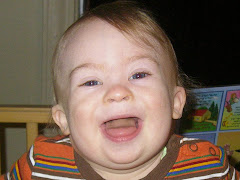
 This is pretty much what conversations with Mendele look like. After saying "ooh" 5 or 6 times, Mendele makes the "ooh" shape with his mouth. Once in a while there is an "ooh" sound as well. -Holding the camera and talking to him, the picture is a bit lopsided.
 We're working on this... but he does look pretty darned cute with his tongue hangin' out!
 Anyways, Mendele is getting tired so...aaah...
 ...zzz...